Mechanical borehole surveying clock
HTC-203: Mechanical borehole surveying clock
Donor: Associação Brasileira de Mecânica dos Solos e Engenharia Geotécnica (ABMS)
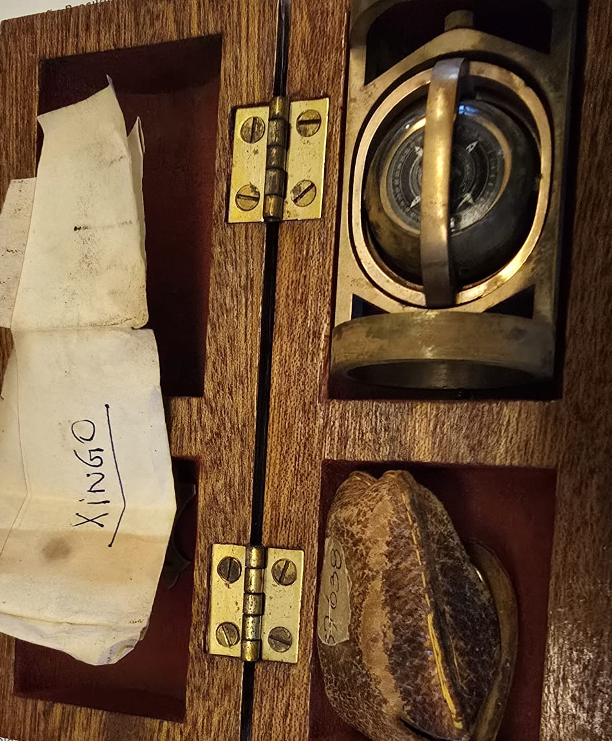
This object represents a formative stage in the evolution of geotechnical investigation practices, particularly in Brazil, where instruments of this type were used throughout the 1980s and 1990s in mining, dam engineering, and large civil works. Before digital inclinometers and electronic downhole logging became accessible in the country, mechanical gimballed clocks played an essential role in borehole deviation control and subsurface mapping—especially in remote regions where robust analogue tools were the only reliable option.
The heritage value of this artefact lies in several dimensions:
Historical significance for Brazilian geotechnics: This instrument typifies the analogue era of field investigation that supported major Brazilian infrastructure expansions, including tailings dams, railways, mine development in the North and Midwest, and early hydrogeological surveys. Many pioneering Brazilian geotechnical firms and universities relied on tools like this before modern instrumentation became available.
Technological evolution: It provides a clear snapshot of the transition from mechanical orientation methods to the digital inclinometry and gyroscopic surveying systems now standard in the country. This mechanical clock, protected in a gimballed frame, demonstrates how engineers once obtained essential subsurface information through ingenuity rather than electronics.
Field-based identity of the profession: The object captures the dual nature of geotechnical work in Brazil—scientifically rigorous yet executed in challenging field conditions, often in remote tropical environments where analogue robustness was indispensable.
International relevance: While rooted in Brazilian practice, similar tools were used worldwide. The object is therefore both a national historical marker and a representative symbol of global geotechnical heritage.
Educational and cultural value: Future engineers will find in this device a tangible example of how earlier generations conducted borehole investigations under technological limitations. It is visually intuitive, scientifically meaningful, and serves as a bridge connecting past practice with modern innovation.
This analogue borehole surveying clock offers a compact yet powerful story: how geotechnical engineering in Brazil, during the 1980s–1990s, advanced in the field with practical mechanical tools, progressively building the foundation for today’s high-precision, data-driven subsurface characterization.